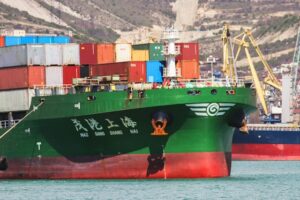

In a move likely to please shipping companies, the U.S. announced it may delay the Nov. 10 date for reactivating a port fee that would cost Chinese ships docking at American ports millions of dollars.
The U.S. Trade Representative (USTR) proposed extending, by two months, its pause on Section 301 maritime fees and related duties aimed at China’s maritime, logistics and shipbuilding sectors. The announcement, posted in the Federal Register on Oct. 23 raised hopes for negotiations that will kill the planned fees, which would likely spur retaliatory fees from China.
The fees could ultimately be quashed as part of overall trade discussions between the U.S. and China, with the next summit set for November.
“The United States is continuing to engage with China with the goal of obtaining the elimination of the acts, policies, and practices at issue in the investigation,” Jennifer Thornton, general counsel for the USTR says in the Federal Register notice.
Background and costs
The initial plan for a shipping fee on Chinese vessels followed a 2024 petition from five U.S. labor unions that spurred a USTR Special 301 investigation. USTR’s investigation found that China’s acts, policies, and practices targeting the maritime, logistics, and shipbuilding sectors for dominance burdened or restricted U.S. commerce.
The shipping fees took effect and remained in force briefly in 2025. The initial rate for a China-owned or -operated vessel was $50 per net ton, while the charge for a covered Chinese-built vessel was the higher of $18 per net ton or $120 per discharged container. During the short period when the charges were active, U.S. carrier Matson reported incurring $6.4 million in reciprocal Chinese port fees. China’s state-owned COSCO, meanwhile, faced estimated annual U.S. charges of $1.5 billion.
The fees took effect on Oct. 14, 2025, before USTR suspended the action from Nov. 10, 2025, through Nov. 9, 2026. That one-year pause followed a U.S.-China trade and economic deal announced after the Trump-Xi meeting in Busan.
The proposed extension of the pause covers fees on China-owned or -operated vessels, eligible Chinese-built vessels operated by non-Chinese companies, and foreign-built vehicle carriers. It also covers 100% additional duties on specified ship-to-shore cranes, intermodal chassis, parts, and certain cargo-handling equipment.
Industry seeks continued relief
Shipping companies should be relieved by the extended pause in fees. In a September 23 letter, more than 200 trade associations, including the National Retail Federation, American Apparel & Footwear Association, Footwear Distributors & Retailers of America, and the World Shipping Council, asked USTR to keep the fees suspended.
“Resuming the Section 301 vessel fees at this time would add another cost layer to an already strained transportation system. Because China-built vessels represent a meaningful share of global ocean carrier capacity, the practical effect of the tariffs and fees would not be limited to a narrow set of market participants,” said the letter.
It added, “Instead, the costs would ripple across shipping networks, affect vessel deployment decisions, and increase uncertainty for businesses that have limited ability to control the ownership, operation, or construction history of the vessels used to transport their goods.”
Factors supporting a longer suspension
Suspension could last beyond January if U.S.-China trade discussions continue to advance. Trump and Xi met in September and are expected to meet again in November. Separately, China has committed to purchase at least 10 million metric tons of U.S. coal in both 2027 and 2028. Although USTR has not identified the coal commitment as a reason for delaying the vessel fees, a longer pause could limit shipping-cost uncertainty for exporters serving that trade.
Disruptions around the Strait of Hormuz have also increased energy and freight costs, adding to the macro backdrop for an extension. September’s Consumer Price Index increased 3.7% from a year earlier, while gasoline prices rose 9.1% during the month. With affordability likely to be a major midterm issue, avoiding an additional freight-related cost may be politically easier to defend.
Uncertainty persists
The fundamental rationale for the fees remains China’s large and expanding shipbuilding position. China’s Ministry of Industry and Information Technology reported that Chinese yards captured 81.8% of global new ship orders, measured by deadweight tonnage (DWT), during the first nine months of the year. New orders totaled more than 175 million DWT, up 163% from a year earlier, while completed tonnage reached about 58 million DWT.
Advocates for restoring the fees argue that they are necessary to respond to China’s advantage in shipbuilding and encourage demand for vessels built in the United States. In June, Senators Mark Kelly and Elizabeth Warren wrote, “Section 301 port fees are critical to revitalizing U.S. shipbuilding,” citing China’s outsized role in global commercial ship production and the comparatively limited U.S. industry.
The uncertain policy timetable is also making businesses more cautious about long-term investment, hiring, and vessel-deployment decisions. Liquid-bulk brokers are monitoring the situation rather than committing to major changes, while some shippers have also accelerated imports in response to trade-policy and fuel-cost uncertainty. Any action affecting container shipping could have implications for chemical supply chains, as container vessels carry pelletized polymers such as polyethylene and polypropylene.
An approved extension would offer temporary relief for companies trading between the United States and China, but it doesn’t settle the fundamental drivers.
If approved, the proposal would prolong the current suspension from 12:00 a.m. Eastern Time on Nov. 10, 2026, until 11:59 p.m. Eastern Time on January 9, 2027. USTR has opened docket USTR-2026-0694 for public comments, with submissions due by 5 p.m. Eastern on Oct. 30.